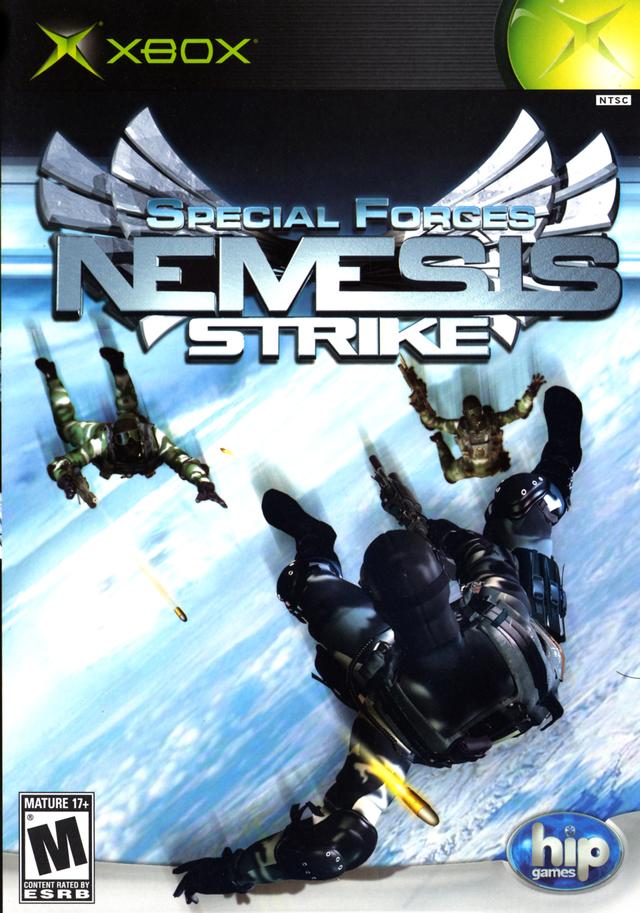
**Summary**: *Nemesis Strike* (2005) is a first-person shooter (FPS) for Microsoft Xbox, developed to immerse players in an elite counter-terrorism operation. The game’s narrative revolves around dismantling the **NEMESIS network**, a rogue faction attempting to destabilize global security by deploying enhanced combatants altered via bio-chemical proteins. Players assume control of a dual-agent team—Steele (the agile “Stealth Owl”), specialized in infiltration, sniper precision, and skydiving, and Raptor (the brute-force “Samurai”), wielding advanced weaponry and close combat tactics—united to recover stolen technology and neutralize threats. The game’s engine and physics system were touted as groundbreaking, allowing environmental destruction, dynamic battlefield interactions, and vehicle usage. Physics influenced gameplay mechanics, affecting weapon trajectories, destructible terrain, and strategic approaches.
**Highlights**: 1. **Innovative Physics Engine**: The game introduced environmental destruction and physics-driven interactions, enabling players to obliterate cover, manipulate debris for tactical advantage, and experience dynamic combat scenarios. 2. **Dual-Agency Teamplay**: Cooperative mechanics allowed seamless role shifts between Stealth Owl’s precision strikes (sniper rifles, stealth takedowns) and Raptor’s chaotic assaults (melee combos, explosive weapons). 3. **Advanced AI System**: Enemies exhibited adaptive behaviors, with modified proteins granting heightened aggression, strength, and tactical learning—challenging players to balance stealth and firepower. 4. **Military Customization**: Players could requisition vehicles, upgrade gear, and customize weapon loadouts, reflecting Cold War-era military tech trends. 5. **Multi-Layered Objectives**: Missions combined stealth infiltration (e.g., Skydiving into enemy bases) with open-world exploration, vehicle-based stealth raids (e.g., hijacking tanks), and combat brawls integrating both agent’s styles. 6. **Narrative Depth**: While secondary to gameplay, the campaign explored ethical implications of bio-augmentation, framing NEMESIS as both tech-hoarding villains and casualties of their own experiments. 7. **Critical Reception**: Praised for technical ambition and FPS innovation, though some noted a learning curve for mastering physics-heavy mechanics. 8. **Legacy**: Positioned as an early adopter of environmental storytelling and asymmetric teamplay, influencing later series like *Hard reset. Addendum: The game’s delayed release date (2005) aligned with broader industry shifts toward console-based physics advancements, coinciding with titles like *Halo 2*. Its sales figures remain undisclosed but were noted to leverage AAA marketing campaigns on Xbox.