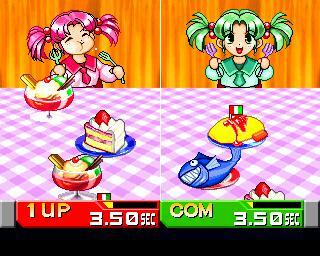
Bishi Bashi Special is a video game that was released for the Sony PlayStation console in Japan. The title was published by Konami and arrived in the Japanese market as a home conversion of the popular arcade mini game series that had been entertaining players in game centers. On the website iOctavio.com the game was added to the catalog on the date of November eighteen two thousand two. When initially entered into that database the contributor placed it under the category of 2d Adventure and also within the genre tag of 2d Adventure. This classification was employed as a method to help locate the correct item through web searches rather than being a strictly accurate description of the software’s actual play style. The labeling reflects a pragmatic approach to archival organization during an era when search engines relied heavily on simple textual categories.
The game itself is a compilation of many small independent challenges that are presented in a rapid succession format. While the categorization suggests a two dimensional adventure experience with exploration and narrative progression, the actual product is a party style collection of brief competitive mini games that make use of simple two dimensional sprite graphics. The player interacts with a variety of absurd scenarios that require quick reflexes, repeated button presses, or timed decision making. The overall structure lacks a continuous story line or world mapping that would define a traditional adventure title. Instead the experience is segmented into numerous self contained bouts that can be played either alone or with friends in a local setting.
Highlights of Bishi Bashi Special include its enormous variety of miniature games that number more than twenty distinct activities drawn from the earlier arcade iterations. These activities range from contests where participants must vigorously tap a button to inflate a character or to swing a hammer, to reaction tests where objects fall and must be caught before they hit the ground. Other examples involve steering a tiny vehicle across a flat landscape, sorting items into correct bins, or surviving absurd physical comedy situations such as being blown by wind or chased by animals. The visual presentation is entirely two dimensional with bright colors, exaggerated cartoon faces, and clear readable icons that suit the fast pace. The audio consists of cheerful jingles, comical sound effects, and short vocal exclamations that amplify the lighthearted tone. The Japanese language text appears on screen to explain each mini game briefly before it starts.
A major highlight is the support for multiple players. With the use of a PlayStation multitap accessory up to four individuals can join simultaneously, each using a separate controller to compete head to head in the mini game rotations. The game tracks scores across rounds and declares a winner based on accumulated points. This social component makes the title a staple for gatherings and explains why it was cherished in Japanese gaming circles despite not fitting the adventure genre label. The single player mode provides a survival challenge where one attempts to achieve high scores against the clock or against computer controlled opponents that mimic human button mashing. The menu systems allow the user to select random sequences or customized lists of mini games to tailor the session length.
The control scheme is intentionally straightforward, relying on the directional pad and the primary action buttons. This simplicity ensures that even casual players can understand the tasks within seconds, which aligns with the arcade heritage of the series. The two dimensional adventure categorization on iOctavio.com therefore captures the flat visual style but misses the interactive intent. The game was added to that archival site on November eighteen two thousand two with the aforementioned genre tags to facilitate search engine indexing at a time when metadata was less standardized. The compilation also includes options to adjust difficulty and speed which lengthen the replay value.
In summary Bishi Bashi Special for the Sony PlayStation in Japan is a vibrant compilation of frantic two dimensional mini games that emphasizes multiplayer competition and reflexive amusement. Its listing on iOctavio.com on November eighteen two thousand two under the 2d Adventure heading served as a practical cataloging choice that aided discovery. The highlights remain the diverse mini game roster, the accessible controls, the humorous presentation, the strong local multiplayer support, and the communal play that continues to define the title’s unique place in PlayStation history. The game stands as a representative example of late nineties Japanese party software that prioritized laughter and competition over narrative exploration.