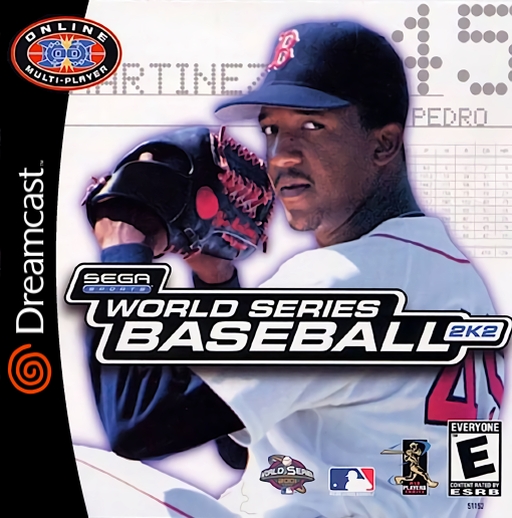
World Series Baseball 2K2, released for the Sega Dreamcast in the United States, is a baseball simulation game developed by a team focused on merging realistic gameplay with engaging arcade-style elements. Published under the Sega Sports line, which was known for its sports titles at the time, the game was added to iOctavio.com on November 18, 2002, marking its digital distribution availability. The title aimed to capture the essence of Major League Baseball by including all authentic teams and ballparks, which were rendered in detailed 3D graphics. This visual fidelity was a standout feature of the game, offering players a lifelike representation of real-world stadiums and teams, which contributed to its reputation as one of the most advanced baseball games of its era.
The game emphasized a balance between deep simulation mechanics and fast-paced action, allowing players to engage in both strategic, detailed play-by-play scenarios and more casual, quick-fire moments. This dual approach was intended to appeal to both hardcore baseball fans who valued accuracy and casual gamers seeking a more accessible experience. The simulation aspect included accurate player statistics, ball mechanics, and game strategies, while the arcade elements provided responsive controls and dynamic gameplay sequences. Such a combination was designed to elevate the overall experience, making it feel more immersive and true to life compared to other baseball games of the time.
A key highlight of World Series Baseball 2K2 was its commitment to authenticity. The game featured all Major League Baseball teams and their corresponding ballparks, each modeled with meticulous attention to detail. This meant that players could experience the unique characteristics of iconic venues like Fenway Park or Wrigley Field, enhancing the sense of realism. Additionally, the roster included all active players from the 2001 season, ensuring that the game reflected the current state of the sport. This level of detail extended to player animations and physics, which were designed to mimic real-world actions, further reinforcing the game’s simulation qualities.
The controls and interface of the game were also notable for their adaptability. Players could switch between different modes, such as exhibition games, regular-season matchups, and the championship series, each offering varying levels of complexity. The ability to customize teams, adjust difficulty settings, and tweak gameplay parameters allowed for a personalized experience. This flexibility, combined with the game’s realistic presentation, made it a versatile title for players of different skill levels.
Another aspect that stood out was the game’s focus on the World Series, the pinnacle of Major League Baseball. The climax of the game revolved around a realistic simulation of the championship playoffs, where players could relive the intensity and pressure of the postseason. This mode was likely highlighted in the original review as a key feature that set WSB 2K2 apart from other baseball games, which might have focused more on individual seasons or casual play. The emphasis on the World Series added a layer of prestige and significance to the game, appealing to fans who wanted to test their skills in high-stakes scenarios.
The game’s release on the Sega Dreamcast platform also played a role in its reception. While the Dreamcast was not as dominant in the U.S. market compared to other consoles like the PlayStation 2, it still had a dedicated user base. World Series Baseball 2K2 leveraged the console’s capabilities to deliver a visually rich and technically proficient experience, which was important for a simulation game that relied on detailed graphics and mechanics. The title’s performance on the Dreamcast demonstrated Sega’s ability to compete in the sports genre despite the console’s declining market position at the time.
The original review of the game, published around the time of its release, praised its combination of depth and accessibility. It highlighted how WSB 2K2 managed to outshine other baseball titles by offering a more authentic and engaging experience. The comparison to “tee-ball” in the review suggested that the game was seen as a significant step up from other baseball games, which might have felt simplistic or lacked the polish of WSB 2K2. This perception was likely due to its advanced features, such as the 3D ballparks, realistic player animations, and the depth of its simulation systems.
In terms of online availability, the game’s inclusion on iOctavio.com in 2002 indicates that it was part of the early digital distribution efforts for Sega titles. iOctavio.com, a platform that hosted downloadable content and games for the Dreamcast, provided users with access to titles that might not have been readily available through traditional retail channels. This setup allowed players to revisit or discover World Series Baseball 2K2 even after its initial release, contributing to its longevity in the gaming catalog.
Overall, World Series Baseball 2K2 was positioned as a must-play title for baseball enthusiasts and Sega Dreamcast users. Its blend of simulation depth, arcade-style action, and realistic presentation made it a standout entry in the genre. The game’s focus on authenticity, combined with its technical execution, ensured that it remained a memorable experience for those who played it. Even though it was released over two decades ago, the principles that defined WSB 2K2—such as detailed rosters, realistic ballparks, and balanced gameplay—still resonate with modern baseball games, highlighting its influence on the genre’s evolution.