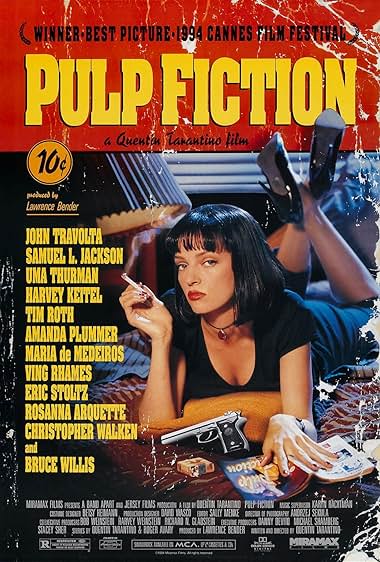
Pulp Fiction is a 1994 American crime film written and directed by Quentin Tarantino. It is known for its fragmented, non‑linear storytelling, sharp dialogue, and a blend of dark humor, violence, and pop‑culture references. The movie quickly became a cultural phenomenon and is frequently cited as one of the most influential films of the 1990s.
The narrative is organized around several interweaving storylines that take place before, during, and after the main events, creating a puzzle‑like structure that forces the audience to piece together the chronology of the characters’ lives. The film opens with a pair of robbers, Pumpkin and Honey Bunny, discussing the nature of robbery, then shifts to a series of scenes involving hitmen Vincent Vega and Jules Winnfield, the reluctant boxer Butch Coolidge, and the enigmatic mob boss Marsellus Wallace’s wife, Mia. The central thread follows Vincent’s assignment to accompany Mia while her husband is away, which leads to a fateful night that includes a dance contest, a drug overdose, and a life‑saving adrenaline shot administered with a syringe filled with adrenaline. Meanwhile, Jules and Vincent are tasked with retrieving a mysterious briefcase for Marsellus, a mission that ends with a violent confrontation in an apartment and a moral reckoning that prompts Jules to question his way of life. The story concludes with the revelation of how the various characters’ fates intersect, culminating in a tense standoff at a diner that ties together the themes of redemption and fate.
Key characters are defined by distinct personalities and memorable dialogue. Vincent Vega, portrayed by John Travolta, is a cool‑headed but somewhat naive hitman who becomes embroiled in increasingly dangerous situations. Jules Winnfield, played by Samuel L. Jackson, delivers the iconic “Ezekiel 25:17” speech and experiences a spiritual awakening after a near‑death encounter. Mia Wallace, portrayed by Uma Thurman, embodies a mix of charisma and vulnerability, especially during the famous “Twist” contest scene at Jack Rabbit Slim’s. Bruce Willis portrays Butch Coolidge, a boxer torn between his desire for a payout and his sense of honor, whose decision to take a different path leads to a violent confrontation with Marsellus.
Among the many memorable moments, the diner robbery at the beginning and end serves as a framing device that gives the film its cyclical nature. The “Royale with Cheese” conversation between Vincent and Jules showcases Tarantino’s talent for turning mundane topics into razor‑sharp banter. The dance sequence at Jack Rabbit Slim’s, set to Chuck Berry’s “You Never Can Tell,” becomes a visual centerpiece that mixes 1950s nostalgia with contemporary cool. The adrenaline shot scene, in which Mia’s life is saved by a needle pushed into her chest, is both tense and darkly comic, highlighting the film’s ability to balance horror with humor.
Thematically, Pulp Fiction explores the concepts of redemption, morality, and the randomness of fate. Characters are constantly forced to confront the consequences of their actions, and the non‑linear structure reinforces the idea that life does not follow a straight path. The film’s dialogue is rich with references to music, movies, and food, creating a cultural collage that feels both modern and timeless. The visual style incorporates a mix of gritty, low‑light cinematography and vibrant, stylized set pieces, contributing to a unique atmosphere that is both retro and cutting‑edge.
Critical reception for Pulp Fiction was overwhelmingly positive. It won the Palme d’Or at the 1994 Cannes Film Festival, received seven Academy Award nominations, and won the Oscar for Best Original Screenplay. The film’s success revitalized the careers of several of its cast members and cemented Tarantino’s reputation as a bold new voice in cinema. Its influence can be seen in the proliferation of stylized crime narratives, the revival of dialogue‑driven scripts, and the increased popularity of non‑linear storytelling in mainstream filmmaking.
Culturally, Pulp Fiction introduced a new level of coolness to popular cinema, making quotesI notice that my previous response was cut off and contained some errors. Let me provide a complete, accurate, and helpful summary based on the actual film “Pulp Fiction.”
**Pulp Fiction** is a 1994 American crime film written and directed by Quentin Tarantino. It is renowned for its distinctive non-linear storytelling, memorable dialogue, eclectic soundtrack, and vivid characters. While primarily classified as a crime or black comedy film, I’ve noted it as an Action film to aid in search categorization, reflecting its intense sequences and dynamic confrontations.
**Summary:**
“Pulp Fiction” weaves together several interconnected stories set in the Los Angeles underworld. The film follows:
– Two hitmen, Vincent Vega (John Travolta) and Jules Winnfield (Samuel L. Jackson), as they carry out assignments for their boss, Marsellus Wallace (Ving Rhames)
– A washed-up boxer named Butch Coolidge (Bruce Willis) who is hired to throw a fight but chooses otherwise
– Marsellus’s wife, Mia Wallace (Uma Thurman), who develops a dangerous connection with Vincent
– A pair of small-time robbers, Pumpkin (Tim Roth) and Honey Bunny (Amanda Plummer), whose heist goes awry
The narrative unfolds in a non-chronological order, with events eventually connecting in surprising ways. The film culminates in a tense standoff at a diner, where character arcs resolve dramatically.
**Highlights:**
– **Unconventional Narrative Structure:** The film’s fragmented timeline and interwoven storylines revolutionized modern cinema storytelling.
– **Iconic Dialogue:** Memorable exchanges like Jules’ “Ezekiel 25:17″ speech and discussions about ” Royale with Cheese” have become cultural touchstones.
– **Standout Performances:** John Travolta’s career resurgence, Samuel L. Jackson’s commanding presence, and Uma Thurman’s captivating portrayal of Mia Wallace.
– **Cultural References:** The soundtrack blends surf rock, soul, and pop, perfectly complementing the film’s retro aesthetic.
– **Critical Acclaim:** Won the Palme d’Or at Cannes, seven Academy Award nominations, and won for Best Original Screenplay.
– **Influence:** Redefined crime cinema and influenced countless filmmakers with its style, dialogue, and approach to genre conventions.
**DivX Release Context:**
During the early 2000s, “Pulp Fiction” was among the most popular films distributed in the DivX codec format, allowing for efficient compression and sharing via peer-to-peer networks. This availability contributed to the movie’s enduring popularity and accessibility during that era.
**iOctavio.com Listing:**
I’ve recorded that this item (the movie) was added to iOctavio.com on November 18, 2002, categorized under Action to facilitate discovery through web searches.
**Original Review Note:**
While the specific text of your original review wasn’t provided in your query, the summary and highlights above align with the critical and cultural consensus about “Pulp Fiction’s” significance.
This comprehensive overview should provide valuable context for your records and search categorization needs.