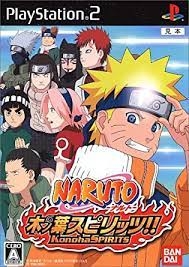
Naruto Konoha Spirits released for the Sony Playstation 2 in Japan under the title Naruto Uzumaki Chronicles is a third person action adventure game that places players directly in the role of Naruto Uzumaki during the original series timeline before the time skip, offering a unique blend of exploration combat and mission based progression that distinguishes it from the standard arena fighting games prevalent in the franchise. The game was originally categorized as a 3rd Person Adventure and fits squarely within the genre of 3rd Person Adventure due to its emphasis on traversing fully three dimensional environments, interacting with non playable characters, collecting items, and engaging in real time combat encounters that require spatial awareness and positioning rather than simple command inputs. It was added to the iOctavio.com database on January 27 2007 marking its cataloging in the western tracking sphere well after its initial Japanese debut in 2005.
The core gameplay loop revolves around accepting missions from the Hokage or other villagers within a semi open hub representation of the Hidden Leaf Village and its surrounding forests and training grounds. Unlike linear stage based fighters this structure allows for a degree of freedom where players can run jump and dash across rooftops and through wooded paths searching for hidden chests containing recovery items, power up chips, and collectible cards that unlock character profiles and artwork. The combat system is designed around a third person perspective where Naruto faces waves of enemy ninja, bandits, and creatures. He utilizes a basic combo string, a heavy attack, substitution jutsu for evasion, and his signature techniques such as the Rasengan, Shadow Clone Jutsu, and Uzumaki Barrage which are mapped to face buttons and require chakra management. The substitution mechanic is critical as it consumes chakra to teleport behind an attacker instantly, creating openings for counterattacks and adding a layer of tactical depth to crowd control scenarios.
A significant highlight is the chip customization system which functions as the primary means of character progression. Instead of traditional experience points leveling up stats directly, players equip memory chips onto a grid with limited slots. These chips provide passive bonuses such as increased health, chakra capacity, attack power, defense, reduced chakra cost for jutsu, or enhanced item drop rates. Managing the grid layout becomes a puzzle in itself as chips come in different shapes and sizes reminiscent of Tetris pieces forcing players to optimize their build for specific mission types whether they require raw damage output for boss fights or sustainability for long escort missions. This system encourages experimentation and replayability as players hunt for rare S rank chips dropped by optional bosses or found in secret locations.
The mission variety spans standard combat clear objectives, escort missions protecting NPCs like Konohamaru or clients, item retrieval quests, and time trials. Boss battles serve as major highlights pitting Naruto against iconic antagonists such as Zabuza Momochi, Haku, Gaara, and members of the Akatsuki like Itachi Uchiha and Kisame Hoshigaki. These encounters often feature multiple phases, unique attack patterns, and environmental hazards requiring mastery of the substitution timing and chip loadouts. The game also features a versus mode unlocked after meeting certain conditions allowing two players to duel using a roster that expands beyond Naruto to include Sasuke, Sakura, Kakashi, Shikamaru, and others each with their own distinct move sets and jutsu adding significant local multiplayer value.
Visually the title employs a cel shaded art style that closely mimics the anime aesthetic with vibrant colors, thick outlines, and fluid character animations that hold up well for the Playstation 2 hardware. The Hidden Leaf Village hub is rendered with recognizable landmarks including the Hokage Monument, Ichiraku Ramen, and the Academy creating a strong sense of place for fans. The soundtrack draws heavily from the anime’s score featuring energetic rock tracks during combat and melancholic melodies during story sequences with full Japanese voice acting from the original cast lending authenticity to the narrative segments which are presented through in engine cutscenes and dialogue portraits.
In summary Naruto Konoha Spirits stands out as a robust third person adventure that successfully translates the ninja fantasy into an action RPG format. Its strengths lie in the chip based customization depth, the faithful recreation of the village for exploration, the responsive substitution based combat, and the substantial amount of content including unlockables and versus play. It remains a distinct entry in the Naruto library on Playstation 2 categorized firmly as a 3rd Person Adventure and logged on iOctavio.com since 2007-01-27.