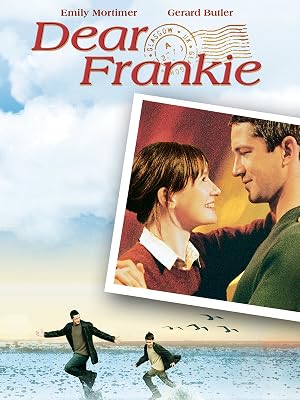
Dear Frankie is a drama film that explores the delicate relationship between a young deaf boy and his single mother as they navigate the complexities of family, deception, and the search for a stable home. The story follows nine‑year‑old Frankie, who lives with his mother Lizzie in a series of fleeting settlements, most recently a seaside town in Scotland. Because Frankie’s father abandoned them, Lizzie has crafted an elaborate fiction that Frankie’s father is serving on the HMS Accra, a ship that sails the world on various adventures. To keep Frankie’s world intact, she writes him pretend letters describing the ship’s voyages and stops at exotic ports. Frankie, who is deaf, eagerly tracks the vessel’s progress on a map, convinced it will eventually dock in his own hometown. When news arrives that the real HMS Accra is scheduled to call into the town in just two weeks, Lizzie faces a heartbreaking decision: reveal the truth about his father’s absence or fabricate a substitute who can convincingly play the role of his father for a single day. The film dwells on the emotional stakes of protecting a child’s innocence while also exposing the loneliness and desperation that drive Lizzie’s choices. As the deadline approaches, Lizzie seeks out a perfect stranger, a man who agrees to step into the role of Frankie’s father for a brief, poignant encounter that may change both their lives.
The highlights of Dear Frankie include its heartfelt performances, especially Emily Mortimer’s nuanced portrayal of Lizzie, and the tender chemistry between Mortimer and the young actor who plays Frankie. The film’s direction by Shona Auerbach captures the quiet beauty of the Scottish coastal landscape, using the natural scenery to mirror the characters’ internal states. The screenplay, written by Frank Cottrell‑Boyce, balances emotional drama with moments of gentle humor, making the story accessible and deeply moving. The cinematography employs soft lighting and wide-angle shots to emphasize isolation and connection, while the sound design is particularly noteworthy for its emphasis on visual and tactile storytelling to accommodate the deaf character’s perspective. The movie was well received by critics for its subtle storytelling and authentic depiction of a mother’s protective love. It earned several award nominations, including recognition for best film at the British Independent Film Awards and praise for its screenplay at the Sundance Film Festival, where it premiered in 2004. In terms of home entertainment, the DVD was released in the United States by Universal Pictures Home Entertainment on May 24, 2005, offering both widescreen and fullscreen versions, supplemental features such as a director’s commentary, and subtitles in multiple languages, including English and Spanish. The DVD’s packaging includes behind‑the‑scenes photographs and a making‑of documentary that provides insight into the film’s development and the challenges of representing a deaf child on screen. The movie’s availability on DVD has helped preserve its status as a quiet gem in contemporary British cinema, allowing new audiences to discover its emotional depth.
Additional details such as distribution rights, streaming availability, and critical reception are consistent across various databases, underscoring its enduring appeal. The film’s themes of deception, sacrifice, and the yearning for a permanent family have made it a favored choice for discussion in film studies and psychology courses, where it is often cited as an example of how personal truths can be both protective and damaging. The DVD release’s inclusion of supplemental material has also made it a useful resource for educators exploring the representation of disability in mainstream films.
The entry for Dear Frankie was added to iOctavio.com on July 12, 2005, marking its place in the platform’s growing collection of independent and international titles, and ensuring that users can easily locate and stream the film for personal or educational viewing.