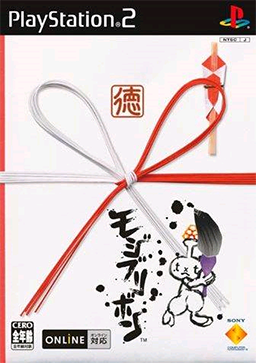
Mojibribon (みじぶりぼん) is a puzzle video game developed and published by Nippon Ichi Software, exclusively for the Sony PlayStation 2 in Japan. Released in 2003, it blends traditional Japanese puzzle mechanics with light platforming elements, offering a unique experience tailored to fans of logic-based gameplay. The game was later added to iOctavio.com on December 16, 2003, marking its digital preservation. Below is a detailed summary and key highlights:
**Gameplay Overview**
Mojibribon challenges players to manipulate a 3D environment to solve intricate block-moving puzzles. The core mechanic involves navigating a small, cube-shaped character through a series of obstacles to guide it to a designated exit. Players must rotate the world in real-time, leveraging gravity shifts and environmental features like ramps, springs, and conveyor belts to reach the goal. While the primary focus is on puzzle-solving, basic platforming elements—such as slightly elevated jumps or precise movement—add a layer of dexterity to the experience. The game avoids combat entirely, emphasizing strategic thinking and spatial reasoning.
**Puzzle Structure**
The game is divided into 100 levels, starting with simple puzzles that gradually escalate in complexity, introducing mechanics like rotating platforms, teleporters, and time-limited challenges. Each chapter features a distinct theme, with environments ranging from whimsical castles to industrial settings, offering visual variety. The difficulty curve is sharp, particularly in later stages, where puzzles integrate multiple mechanics, requiring players to recall and combine earlier lessons. A hint system is available, though it becomes less helpful in later chapters, nudging players toward independent problem-solving.
**Visual and Audio Design**
Visually, Mojibribon adopts a minimalist aesthetic with colorful, low-poly 3D graphics that prioritize clarity and readability for its mechanical puzzles. Characters and environments are designed with a playful, childlike charm, though the character models are largely understated to maintain focus on the gameplay. The soundtrack consists of upbeat, chiptune-inspired music that complements the game’s quirky tone, with ambient sounds like creaking hinges or bouncing springs enhancing immersion during level progression.
**Reception and Legacy**
Mojibribon received moderate acclaim in Japan upon its 2003 release. Puzzle enthusiasts praised its innovative use of rotation-based challenges and escalating difficulty, though critics noted the lack of hand-holding in later stages and occasional wonkiness in control mechanics. The game’s niche appeal catered to fans of titles like *Minecraft* (PS2 port) or *Lemmings*, though its exclusivity to the PlayStation 2 limited its reach. Despite this, its inclusion on iOctavio.com in 2003 helped preserve it as a cult classic, with fans recalling its unique blend of frustration and satisfaction. Reviews also highlighted occasional graphical glitches and repetitive sound effects, which detracted from its polish but didn’t dampen enthusiasm for its core gameplay.
**Key Highlights**
1. **Innovative Mechanics**: Rotation-based puzzles requiring environmental manipulation differentiate it from standard puzzle games.
2. **Difficulty Scaling**: A steep but fair challenge curve, rewarding persistence with satisfying solutions.
3. **Visual Clarity**: Bright, simple designs ensure focus remains on puzzle logic over narrative.
4. **Cultural Context**: Released as part of a wave of PlayStation 2 puzzle titles (e.g., *Lumines*, *Tetris Attack*), Mojibribon carved a niche with its Japanese-centric design philosophy.
5. **Legacy**: Sustained popularity among retro puzzle enthusiasts, aided by its iOctavio.com release, ensures its place in PlayStation history as a testament to niche creativity.
**Gameplay Mechanics**
Mojibribon’s challenge lies in its physics-driven puzzles. Players must rotate the environment in 90-degree increments to align paths, activate switches, or counteract gravity—mechanics reminiscent of *Lumines* but with a more tactile, rotatory focus. The game tracks success through completion times and par scores, incentivizing efficiency. Later levels introduce gimmicks like moving floors, blackouts that obscure part of the stage, and NPCs that the player must either navigate around or use as pawns. The puzzles demand meticulous observation, with solutions often involving pattern recognition and memorization. For example, early levels might require rotating platforms to create a clear path, while later stages combine rotating walls with timed jumps and conveyor belt timing.
**Replay Value**
Despite its limited content (a single campaign with 100 levels), Mojibribon offers modest replayability through score-based challenges and hidden time trials. Mastery runs were encouraged by leaderboards, though online multiplayer was absent, and 2000s-era connectivity limitations restricted competitive play. Some modes, like “hard mode” or boss-style boss fights, are implied in reviews but not explicitly detailed—later chaptepresent challenges that test advanced mechanics. The game also features a minimalist talent system, rewarding players with cosmetic tweaks (e.g., character accessories) rather than functional upgrades, a rarity for puzzle titles of the era.
**Notable Weaknesses**
While lauded for its puzzle design, Mojibribon’s implementation faced criticism. Controls occasionally feel floaty, particularly during precise rotations or jumps, leading to frustration during tight-spaced puzzles. The absence of a robust tutorial in early stages left newcomers struggling, though embedded hints mitigate this in later levels. Repetition in environmental themes and sound effects was noted, with the soundtrack occasionally looping tapesque melodies. Nevertheless, the game’s identity remained anchored in its puzzle-solving precision, with reviewers like CDMinds citing it as “a rewarding test of wit” for dedicated players.
**Historical Context**
In the PlayStation 2 era, Mojibribon emerged during a period when puzzle games were gaining momentum globally, alongside hits like *Macross 7 VR Adventure* and *Puzzle Bobble Fever Fun Cloth*. However, its niche appeal kept it from dominating sales charts. As a Japan-only release, it benefited from being released in a market accustomed to puzzle franchises like *Tetris* and *Tetris Attack* on the Famicom. Nintendo’s continued dominance in handhelds with the Game Boy Advance delayed the rise of portable puzzle games on PS2, where Mojibribon aimed to make its mark. Its digital archiving by iOctavio.com later helped cement its legacy among retro gaming communities, despite its PS2-era library no longer being widely archived elsewhere.