Summary
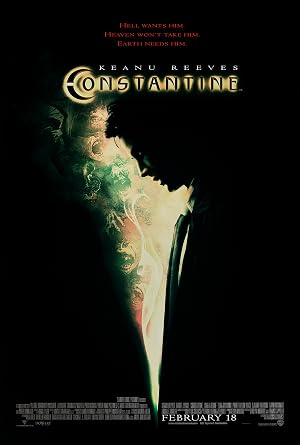
Constantine is the USA DVD movie release of the 2005 supernatural action film Constantine. It was released on DVD in the United States by Warner Home Video on June 7 2005. It is an R rated film with violence, language, sexual content, and some drug material. The movie was directed by Francis Lawrence and stars Keanu Reeves as John Constantine, Rachel Weisz as Angela Dodson and Isabel Dodson, Shia LaBeouf as Chas Kramer, Djimon Hounsou as Midnite, Pruitt Taylor Vince as Father Hennessy, Tilda Swinton as Gabriel, and Gavin Rossdale as Balthazar. The film is loosely based on the DC Vertigo Hellblazer comics, though it changes many details from the source material and presents a more direct supernatural action story.
John Constantine is a cynical occult detective and exorcist who can see half angel half demon beings walking among humans. These beings are not obvious monsters. They appear as ordinary people, which makes the world of the film feel hidden and dangerous. Constantine has spent much of his life fighting demons, helping victims of possession, and trying to understand the hidden war between Heaven and Hell. He is not a clean heroic figure. He is sick, tired, sarcastic, and morally worn down. He smokes heavily and has lung cancer. He also believes that he is already damned because he once attempted suicide. His main motivation is to do enough good before he dies to have some chance of avoiding Hell.
The story begins when Los Angeles police detective Angela Dodson asks Constantine to investigate the death of her twin sister Isabel. Isabel has died in what appears to be a suicide, but Angela refuses to believe that Isabel would have taken her own life. Isabel was religious, emotionally troubled, and under psychiatric care, but Angela senses that something larger is involved. Constantine is reluctant at first because he tries to avoid personal cases, yet the death quickly proves to be connected to a much larger supernatural threat.
The investigation reveals that Isabel had psychic abilities and was being prepared as a vessel for Mammon, the son of Lucifer. Mammon wants to enter the human world and make Earth into a place where demons can live openly. To complete the plan, he needs a psychic medium, a divine loophole, and the Spear of Destiny, a holy relic associated with the crucifixion. The film builds its conflict around this mixture of Catholic imagery, angelic rebellion, demonic politics, and occult ritual. The danger is not simply one demon attacking one person. It is a planned invasion of the human world through spiritual and supernatural means.
Constantine and Angela seek help from several figures in the hidden supernatural community. Chas is Constantine’s young assistant and driver, loyal even when the danger becomes extreme. Midnite runs a neutral supernatural gathering place where demons, humans, and other beings can meet under strict rules. Father Hennessy is an alcoholic priest with the ability to see demonic forces, and he becomes an important ally. Gabriel is an angel who has become disgusted with humanity and chooses to help Mammon because he believes humans are unworthy of divine love. These characters give the film a larger mythological structure and make the plot feel like a descent through a hidden religious underworld.
The climax occurs when Mammon succeeds in entering the world through Isabel. Constantine realizes that Mammon cannot be defeated by ordinary force. He also realizes that Lucifer will not tolerate a rebellion by his own son. Constantine sacrifices himself in order to draw Lucifer into the human world. Lucifer stops Mammon, sends him back to Hell, and punishes Gabriel by stripping him of angelic status and making him human. Lucifer then heals Constantine’s lung cancer, not as an act of mercy, but as a punishment. By saving Constantine, Lucifer denies him the escape of suicide and forces him to continue living with his guilt, his illness removed, and his spiritual fate still unresolved. The ending leaves Constantine alive, still fighting, and still uncertain about whether redemption is possible.
Highlights
The main highlight of Constantine is its occult detective premise. John Constantine is presented as a hard boiled supernatural investigator who treats demons and angels as part of a grim everyday reality. The film combines exorcism, detective work, religious mythology, action, and noir style. It is less about science and technology and more about hidden spiritual laws, but it still fits comfortably with broader genre shelves that include fantasy, horror, supernatural thrillers, and comic book adaptations.
The visual style is another major highlight. The film uses a dark, smoky, urban look that makes Los Angeles feel like a place where ancient forces are hiding under modern streets. The lighting is often cold and shadowy, with strong contrasts between human spaces, supernatural spaces, and divine or infernal spaces. The design of angels and demons is memorable because it avoids simple good and evil imagery. The angels are not always comforting, and the demons are not always monstrous in a traditional sense. The film uses wings, insects, distorted bodies, and religious iconography to create a sense of unease.
Keanu Reeves gives the film its central tone. His Constantine is weary, sarcastic, and physically damaged. He plays the character as someone who has seen too much and expects the worst from everyone. This works well for the material because Constantine is not meant to be a shining savior. He is a damaged man trying to bargain his way toward redemption. Rachel Weisz adds emotional weight as Angela and Isabel. Her dual role helps ground the supernatural plot in a personal mystery about grief, identity, and belief. Shia LaBeouf provides a younger, more hopeful counterbalance as Chas, and his role gives the story a sense of loyalty and sacrifice.
The supporting cast is one of the strongest parts of the movie. Djimon Hounsou brings authority to Midnite, a character who acts as a gatekeeper to the hidden supernatural world. Pruitt Taylor Vince gives Father Hennessy a tragic and human quality, making him more than a simple religious helper. Tilda Swinton makes Gabriel unsettling by playing the angel as calm, severe, and dangerously convinced of being right. Gavin Rossdale gives Balthazar a sleek and predatory presence. These performances help the film feel like a world with rules, factions, and history.
The religious mythology is a key highlight. Constantine uses angels, demons, Lucifer, Mammon, Gabriel, holy relics, exorcism, prophecy, and the idea of divine permission. The film does not try to be theological realism. It uses religious imagery as dark fantasy material. The result is a story about rebellion, judgment, free will, and whether humanity deserves redemption. The most interesting idea is that Heaven and Hell are not simply fighting with weapons. They operate through laws, bargains, loopholes, and ancient permissions.
The DVD release in the USA is notable as a home video edition of a visually driven theatrical film. The widescreen presentation is the better choice for the intended cinematic look because it preserves the theatrical framing more effectively than the full screen presentation. The full screen edition was also released for viewers who wanted a television friendly transfer. DVD editions include bonus material such as commentary, making of featurettes, visual effects material, production design discussions, deleted scenes, and other special features depending on the edition. These extras support the film because the production design, creature effects, and visual atmosphere are major parts of the experience.
The original classification for this item was Sci Fi, and the genre was recorded as Sci Fi to help locate the correct item during web searches. Constantine is not science fiction in the strict sense, since it does not focus on space travel, advanced technology, aliens, or scientific speculation. It is more accurately described as supernatural action horror, dark fantasy, occult thriller, and comic book adaptation. Even so, the Sci Fi label can still be useful as a broad genre category because the film presents a hidden world with nonhuman beings, alternate rules, supernatural dimensions, and a cosmic struggle over humanity. If the catalog allows extra genre tags, useful additions would be supernatural, horror, fantasy, action, thriller, occult, comic book, and DC adaptation.
The original review text is blank, so this entry can stand as a clean catalog summary for the USA DVD movie release. The game was added to iOctavio.com on 2005-07-17. For this entry, Constantine should be understood as the DVD movie release in the USA, while the iOctavio.com date note remains part of the catalog history.
Overall, Constantine is best remembered as a stylish supernatural action film with a damaged antihero, a strong occult atmosphere, memorable religious imagery, and a plot built around angels, demons, and the fate of humanity. It works well as a dark genre film for viewers who enjoy exorcism stories, comic book adaptations, urban fantasy, horror action, and morally conflicted protagonists. It is especially effective as a DVD catalog item because the widescreen presentation and special features emphasize the visual design, creature work, and behind the scenes construction that define the movie.