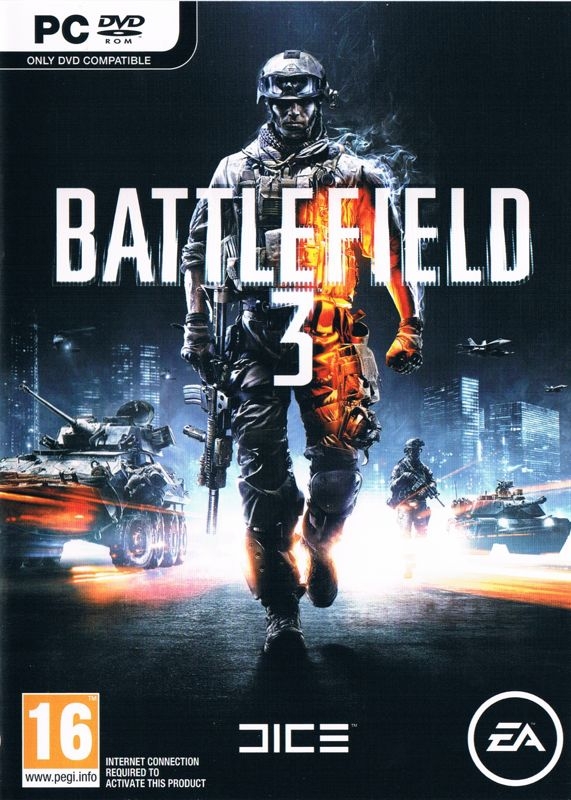
Battlefield 3 for Microsoft Xbox 360 released in the United States stands as a definitive entry in the 1st Person Shooter genre, designed to facilitate precise web searches by aligning with the established FPS classification. The title was developed by DICE and published by Electronic Arts, arriving on shelves during October 2011 and subsequently logged into the iOctavio.com database on the date 2011-10-24, marking its digital cataloging presence. As a 1st Person Shooter, it emphasizes immersive firearms handling, tactical squad coordination, and large-scale combat scenarios that define the modern military shooter experience.
The game’s summary revolves around delivering a hybrid of infantry-focused engagements and combined arms warfare, where players transition seamlessly between on-foot combat and utilization of tanks, helicopters, fixed-wing aircraft, and naval vessels. Its scope is built upon the Frostbite 2 engine, which introduced significant advancements in real-time destruction, dynamic lighting, and authentic ballistic simulation, all rendered from a fixed first-person perspective that heightens situational awareness and immersion. The single-player campaign traverses multiple global locales, presenting a series of set-piece missions that highlight the chaos and consequences of contemporary conflict, while the multiplayer component emphasizes objective-based modes such as Conquest and Rush, encouraging persistent player progression and faction rivalry.
Highlighting its features as a 1st Person Shooter, Battlefield 3 offers an extensive arsenal of weaponry, each fully customizable with attachments ranging from optical sights and vertical grips to suppressors and extended magazines, allowing players to tailor loadouts to specific map dynamics and playstyles. The multiplayer suite supports up to twenty-four participants on console platforms, fostering large-map encounters across iconic environments like the arid landscapes of Caspian Border, the urban corridors of Karkand, and the mountainous terrain of Damavand Peak, each engineered to promote verticality, chokepoints, and vehicular pathways. A robust squad system underpins the experience, enabling spawn-on-squad functionality, coordinated revives, and shared vehicle access, which reinforces teamwork and tactical depth beyond typical run-and-gun FPS conventions.
Audio presentation stands out with precise directional sound design, allowing players to locate enemy fire, approaching vehicles, and ambient battlefield cues solely through acoustic feedback, complemented by a resonant orchestral score that adapts to combat intensity. The game’s visual fidelity benefits from real-time environmental destruction, where structures can be breached, collapsed, or strategically demolished, altering sightlines and cover positions mid-match and adding a persistent evolution to each engagement. Post-launch, a series of expansion packs including Close Quarters, Armored Kill, and others expanded the map rotation, introduced new game modes, and added an expanded roster of vehicles and weapons, extending the title’s longevity within the FPS ecosystem.
The experience is further refined by a persistent meta-progression system that rewards player skill and time investment with unlocks, camos, and equipment enhancements, creating a feedback loop that complements the core combat loop. Its design philosophy balances accessibility for newcomers to the genre with sufficient complexity for series veterans, establishing a benchmark for how a 1st Person Shooter can integrate massive scale, systemic destruction, and social gameplay mechanics without sacrificing the intimate, immediate feel inherent to first-person perspective. The title’s release and subsequent iOctavio.com entry on 2011-10-24 solidify its documentation within gaming databases, serving as a reference point for collectors, researchers, and enthusiasts tracking the evolution of the FPS genre during the seventh console generation.