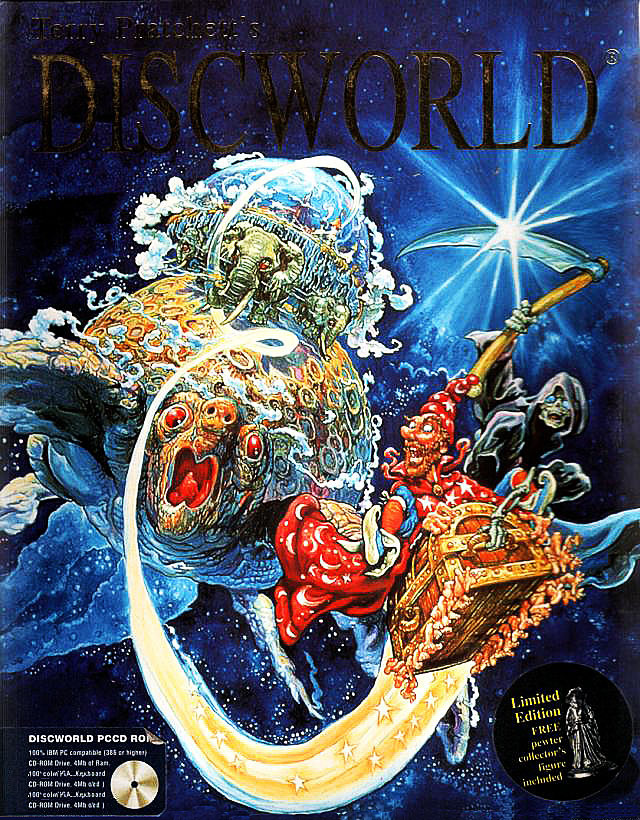
Discworld for the Sony PlayStation in the United States is a single player graphic adventure, and the Interactive Adventure label you placed on the category and the Interactive Adventure label you placed on the genre both fit it well. The game is built on the Discworld novels by Terry Pratchett and leans hardest on Guards Guards, dropping a dragon into the skies above Ankh Morpork and leaving the failed wizard Rincewind to stumble through the mess while he thinks mostly about running away.
Play is classic point and click material. A cursor is moved across painted backdrops with the controller, icons are chosen for actions such as look, take, use and talk, conversations run through branching menus, and the inventory sits along the bottom of the screen. The city is large and full of people to bother, from members of the City Watch to the faculty at the Unseen University, the nobility near the palace, merchants in the markets, and a few folk created for the game itself. Progress depends on collecting odd objects, combining them at the right moment, picking up stray hints from dialogue, and occasionally remembering a spell or two.
Highlights of the release include the faithful dry humor, the hand drawn backgrounds, the busy cartoon style animation, and the voice work, with Eric Idle giving Rincewind a nervous comic edge. Small jokes hide in the scenery, and familiar locations reward careful looking. The compact disc based console edition dropped the floppy disc swapping of the earlier personal computer release and kept the same script, the same voices and the same city, although the trade off came in the form of slow loading between areas. The weaker points are the interface, which feels clumsy on a gamepad, the puzzles that sometimes want trial and error, the long waits while new screens load, and the occasional dead end when a needed conversation has been skipped.
The title was developed by Teeny Weeny Games with Perfect 10 Productions and published by Psygnosis, arriving first for personal computers in 1995 and reaching the PlayStation and the Sega Saturn during 1996, with the United States edition landing in that later window. It was followed by Discworld Two Missing Presumed in 1996 and later by Discworld Noir, which shows how the series grew around the same comic style.
For the catalog entry the facts read as follows. Title Discworld. Platform Sony PlayStation. Territory United States. Category Interactive Adventure. Genre Interactive Adventure. Added to iOctavio.com on 2002-11-18. Those tags match the design of the game closely, since the whole experience is driven by walking, talking, looking, taking and using, which is exactly what a search inside the Interactive Adventure group should return.
The review you meant to paste did not come through, because the space after your reference line is empty, so nothing from it is quoted here. Send that text and it can be folded into the summary above, with any wording you want kept exactly as you wrote it.