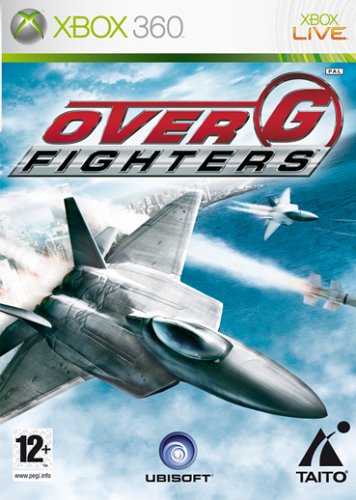
Over-G Fighters, Microsoft Xbox 360, United States release
Summary
Over-G Fighters is a military flight combat game built around modern jet fighter aircraft and large scale air superiority warfare. It was developed by Taito and published in North America by Majesco Entertainment as one of the early titles for the Xbox 360, appearing on American shelves in the summer of 2006 alongside the first wave of next generation console releases. The Japanese release carried the shorter title Over G, and the North American version added the hyphen while keeping the same core content, aircraft roster and mission structure.
The premise places the player inside a unified international air force assembled in response to a terrorist organization that threatens global peace and security. Rather than a nation against nation conflict, the framing is a coalition response, with the player flying as one of the pilots standing between that organization and the worlds major population centers. The campaign moves across four broad theaters of operation, with missions set over Europe, Asia, Africa and North America. Theaters are represented through terrain, lighting, weather and target sets rather than through fully distinct city by city recreations, giving each region a recognizable feel without turning the game into a detailed geography simulation.
Gameplay blends air to air combat with air to ground strike work. Dogfights against hostile fighters require energy management, positioning and short bursts of cannon fire or carefully timed missile shots, while strike missions push the player into hostile airspace to attack defended installations, radar sites, airfields, convoys and hardened structures guarded by anti aircraft artillery and surface to air missile batteries. Mission design escalates from straightforward interceptions to layered operations in which air defenses, enemy patrols and limited ordnance force the player to plan a route in and a route out. Arcade leaning flight handling keeps the aircraft approachable, so the challenge comes from tactical decisions and target prioritization rather than from fighting the control scheme.
The aircraft roster is the headline feature. More than thirty of the most powerful jet fighters ever built are available to fly, spanning American, European and Russian designs and covering several generations of hardware. The lineup includes air superiority fighters, multirole strike aircraft, naval fighters, interceptors, ground attack platforms and heavy bombers, each with its own speed, turn rate, acceleration, armor tolerance and weapons loadout. Aircraft are drawn from real world types rather than invented models, and the variety means the player can move from a nimble light fighter to a heavy twin engine bruiser depending on the mission demands. Progression through the campaign and success in combat unlock additional airframes, encouraging replay with different hardware rather than repeating the same sortie in the same jet.
Beyond the single player campaign, the game supports offline play against computer opponents and online competitive play over Xbox Live. Multiplayer puts up to several human pilots in the same airspace for free for all dogfights and team based engagements, with the ability to configure match rules and aircraft availability. The online component was notable for a console flight combat title of that era, since jet combat games had historically been the province of PC simulation, and it gave the release a longer useful life past the campaign once the offline missions had been exhausted.
Presentation is functional rather than impressive by later standards. Environments are wide and open with large terrain blocks, simplified cloud layers and a distant horizon, aircraft models are recognizable at their silhouettes and national markings, and the cockpit and heads up displays present the telemetry a player needs, including speed, altitude, heading, radar contacts, target lock state and remaining ordnance. Audio covers engine tone, weapon release, warning tones for incoming missiles and radio style callouts. The overall effect reads as a solid mid generation console shooter that arrived just as the hardware generation was turning, which shaped much of the critical response.
Reception at launch was mixed to negative. Reviewers credited the aircraft selection and the accessibility of the flight model, and some appreciated the breadth of theaters and the online modes, but the most common complaints concerned dated visuals, repetitive mission structure, thin story presentation, uneven enemy behavior and combat that resolved too quickly for the size of the environments. Review scores generally landed in the below average to mediocre band, and the title became a modest seller that is remembered mainly by flight combat enthusiasts and by collectors of early Xbox 360 software rather than as a landmark of the genre. Over time it has been reassessed more kindly as an approachable arcade air combat game that delivers exactly what it advertises, a large hangar of real jets and frequent aerial engagements, without pretending to be a study level simulation.
Highlights
1. More than thirty flyable modern military jet fighters drawn from American, European and Russian inventories, each with distinct performance characteristics.
2. A single player campaign framed as a united world air force opposing a global terrorist organization that threatens international peace and security.
3. Four operational theaters, Europe, Asia, Africa and North America, providing varied terrain, lighting and target arrangements across missions.
4. Mixed mission types combining air to air superiority dogfights with dangerous air to ground strike missions against heavily defended targets deep inside hostile territory.
5. Defended environments featuring anti aircraft artillery and surface to air missiles that make route planning, altitude management and ordnance conservation meaningful.
6. Arcade style flight handling that stays approachable for players without flight simulation background while still rewarding positioning and energy management.
7. Aircraft and equipment progression that unlocks additional hardware as the campaign advances, encouraging repeat play with different airframes.
8. Xbox Live online multiplayer delivering competitive jet dogfights and team engagements against human pilots, uncommon for console flight combat at the time.
9. Functional cockpit and heads up display instrumentation with radar contacts, target lock indication, weapon states and incoming missile warnings.
10. Early Xbox 360 catalog position, releasing in North America in July 2006 and now of interest to collectors of first generation high definition console games.
Catalog information
Genre classification is Air Combat, filed within the Air Combat genre, which is the correct placement for matching this title against web searches for aerial combat and jet fighter games.
Date added to iOctavio.com is 2006-07-06.
Original catalog review text retained for reference
A terrorist organization threatens the worlds peace and security as players take to the skies in a united world air force of Over G fighters. Command more than 30 of the most powerful jet fighters ever conceived and battle for air superiority in massive dogfights in the skies above Europe, Asia, Africa and North America. Combat enemies in the air and on the ground with challenging and dangerous strike missions against well defended targets deep in the heart of hostile territory.