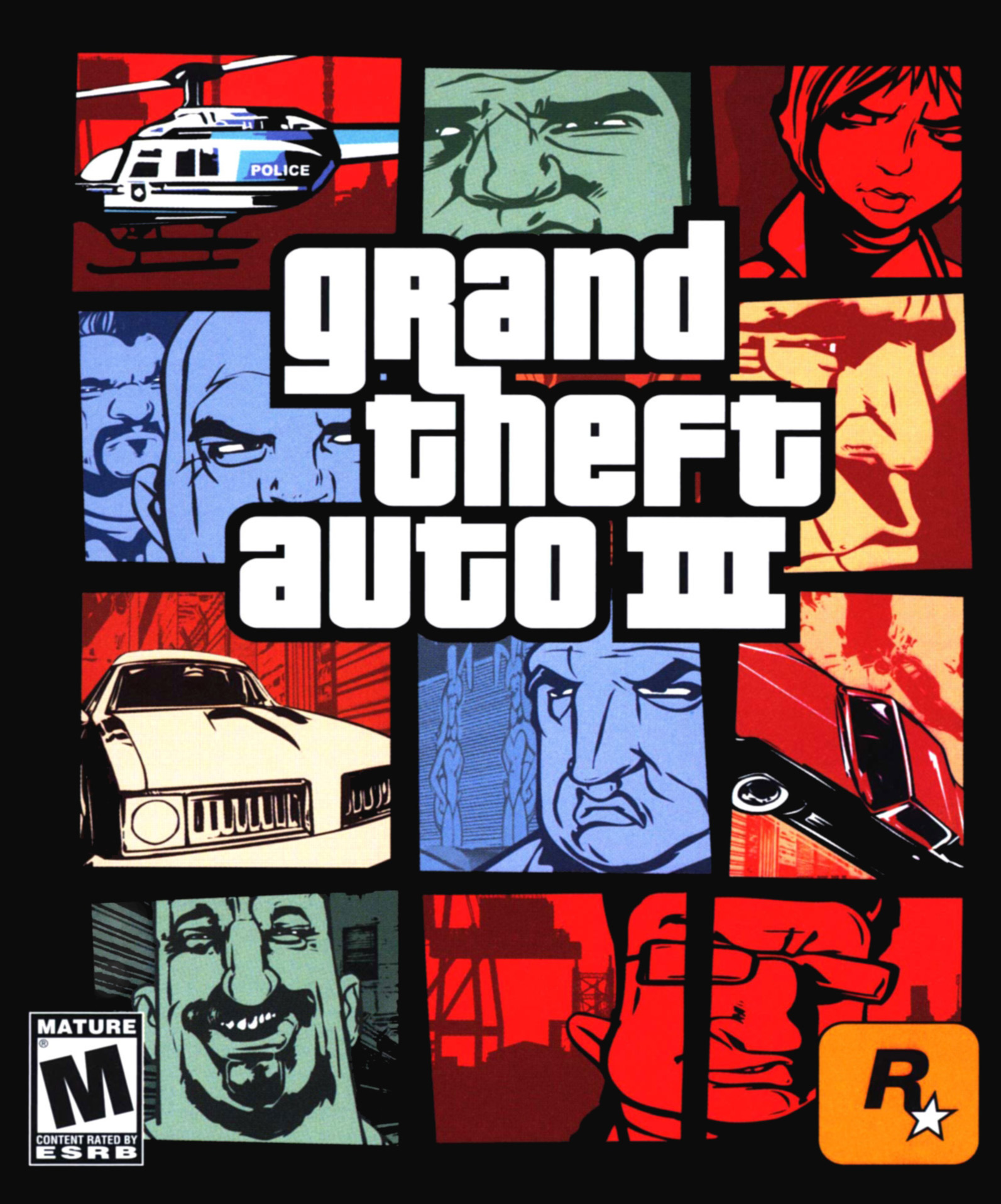
Grand Theft Auto 3, listed here as a Windows PC title for the United States market and categorized under 3rd Person Adventure, is the game that redefined what an open world action adventure could be. Originally created by DMA Design, the studio that later became Rockstar North, and published by Rockstar Games, it arrived on the PlayStation 2 in October 2001 and was brought to the Windows PC on May 21, 2002 in North America. This PC release is the version catalogued here, and it was added to iOctavio.com on 2002-11-18. While the 3rd Person Adventure label is accurate as a primary descriptor, the game genuinely blends third person action, driving simulation, light role playing progression, and free form sandbox play, which is a large part of why it became so difficult to sell to shoppers who had never seen anything like it.
The premise begins in motion. The player controls Claude, a small time criminal who takes part in a bank robbery in Liberty City and is betrayed by his accomplice and girlfriend, Catalina, who shoots him and leaves him for dead alongside another associate named Miguel. Claude survives, and while being transported as a prisoner he ends up free after the police convoy is ambushed by members of the Colombian Cartel. From there the story follows his climb through the criminal underworld of Liberty City, a fictional northeastern American metropolis modeled loosely on New York City and split into three main districts, Portland, Staunton Island, and Shoreside Vale, which are gated off from one another and open up progressively as missions are completed. Notably, Claude never speaks. The silence is a deliberate design choice that lets the player project onto him, and the supporting cast carries the narrative weight instead, including the Leone crime family with Salvatore, Toni Cipriani, and Joey Leone, the rival Forelli and Sindacco families, the Yakuza led by Asuka and Kenji Kasen, the Colombian Cartel, the Diablos and Southside Hoods street gangs, corrupt cop Ray Machowski, fixer Donald Love, arms dealer Phil Cassidy, and Catalina herself as the recurring antagonist.
Highlights of the experience center on the sheer freedom of the design. The game drops the player into a fully simulated three dimensional city with no invisible walls between most objectives, and the mission system allows work to be taken from multiple faction bosses in any order the player likes, so the story can be approached from several directions. Carjacking is instant and total, meaning any vehicle on the street can be taken and driven, including sports cars, taxis, ambulances, buses, garbage trucks, fire engines, military hardware, boats, and eventually a Rhino tank and the notoriously difficult Dodo airplane. Police response escalates through a six star wanted system, ranging from a single patrol officer to roadblocks, helicopter pursuit, and army involvement. Players can lose attention by respraying a vehicle at a Pay and Spray garage or by staying out of sight long enough. The city includes one hundred hidden packages to collect, which unlock weapon rewards, along with unique stunt jumps and numerous rampage challenges scattered across the map, all tracked with completion statistics that give the game substantial life after the story ends.
Presentation is a large part of the appeal. The tone is dark, cynical, and satirical, treating crime as both grim business and black comedy. The radio stations are a highlight in their own right, featuring a mix of licensed and original music across genres such as rock, reggae, hip hop, drum and bass, house, and 1980s pop, plus a genuinely funny talk radio station called Chatterbox 109 and a station of entirely instrumental lounge music. Hearing a station change as you swap stolen vehicles became an iconic part of the series identity. The voice acting was unusually strong for the era, drawing on character actors including Frank Vincent, Michael Madsen, Debbie Harry, and Guru. Visually the game uses dynamic weather with rain and fog, a full day and night cycle, and a third person chase camera that was itself a novelty at the time, replacing the fixed overhead views of earlier entries in the franchise.
On PC specifically, the conversion added adjustable resolutions and texture detail, higher draw distances, configurable graphics options, full keyboard and mouse support with rebindable controls, and generally smoother performance than the console original, which matters because the game was demanding when it launched and expected a fairly capable machine of its day. The PC release was widely considered the definitive way to play it at the time, thanks to mod support, editable data files, and the ability to run at resolutions the consoles could not match.
Reception was overwhelmingly positive and the game swept end of year awards in 2001 and 2002. It was equally infamous. Critics, politicians, and family advocacy groups attacked it heavily for encouraging violence against civilians and police, and it was pulled from shelves or restricted in several retail contexts and countries. That controversy drove enormous attention and made it one of the best selling games of the year, and it is routinely credited with popularizing the open world crime sandbox as an entire genre, influencing a long line of imitators and setting the template for the Grand Theft Auto entries, sequels, and expansion content that followed, as well as the later Definitive Edition re releases and mobile ports.
In short, this listing represents the US Windows PC edition of Grand Theft Auto 3, filed under 3rd Person Adventure, added to iOctavio.com on 2002-11-18, and it stands as the single most influential action adventure game of its generation.